The choice between open vs closed rhinoplasty is not simply a matter of choosing the smaller incision. Both approaches can produce refined, natural-looking results when they are used for the right reasons. The most suitable technique depends on your nasal anatomy, the changes you hope to achieve, whether breathing needs to be addressed, and whether this is a first or revision operation.
Rhinoplasty is a highly individual procedure. A careful consultation should focus first on what is possible safely, rather than on selecting an approach before your nose has been assessed.
What is the difference between open and closed rhinoplasty?
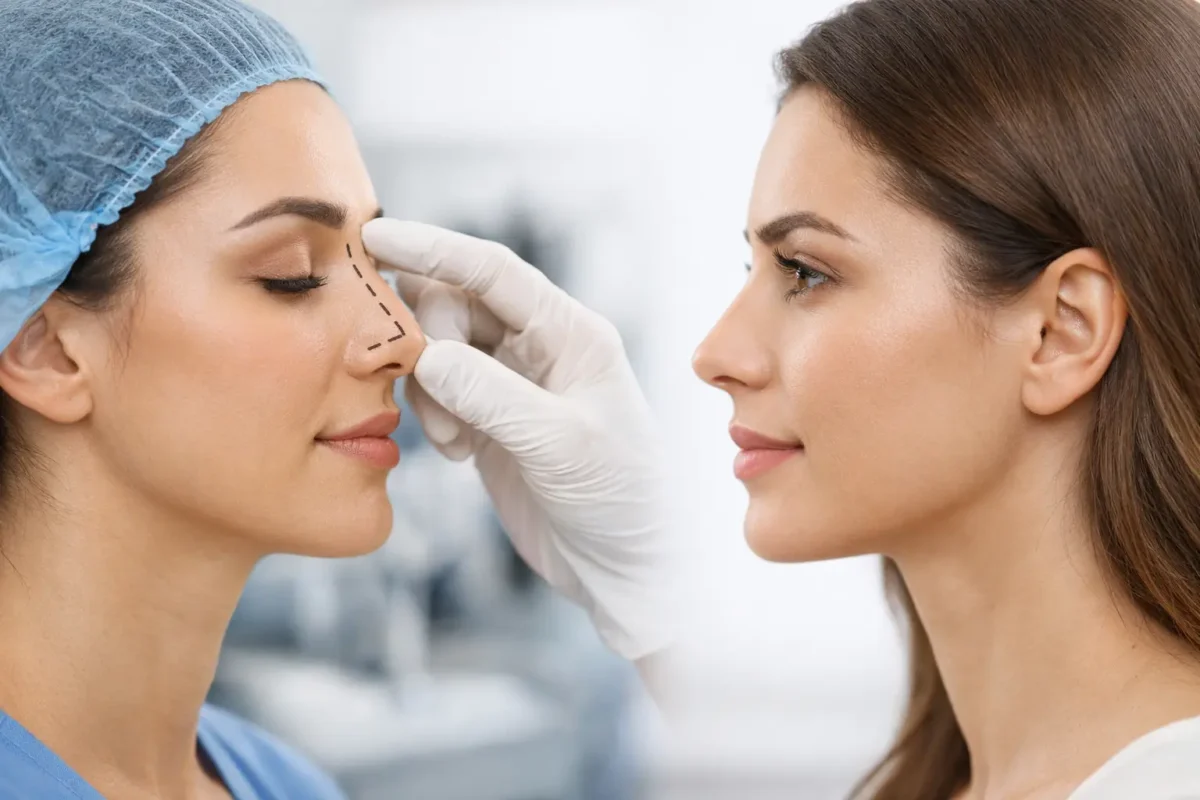
In an open rhinoplasty, the surgeon makes small incisions inside the nostrils and a short incision across the columella, the strip of skin between them. The skin of the nose is then gently lifted to give direct visibility of the underlying cartilage, bone and supporting structures.
In a closed rhinoplasty, all incisions are made inside the nostrils. The surgeon works through these internal openings without lifting the nasal skin in the same way. There is no external columellar scar.
Neither approach is automatically better. They are different surgical routes to the same goal: creating a nose that is balanced with the face, structurally supported and, where possible, functioning well for breathing.
Open vs closed rhinoplasty: the practical differences
The open approach gives the surgeon a broad view of the nasal framework. This can be especially valuable when the tip needs significant reshaping, when cartilage must be repositioned or grafted, or when the nose has been altered by previous surgery or injury. Direct visibility can help with accurate assessment and controlled adjustment of complex structures.
The closed approach can be well suited to selected patients requiring more limited changes, particularly where the nasal bridge needs refinement and the tip structure is already favourable. Experienced surgeons can perform sophisticated work through closed incisions, but the technique requires careful planning and is not ideal for every concern.
The small scar from an open approach is usually placed in a discreet location and, in most patients, fades well over time. Scar quality varies between individuals, however, and it should be discussed honestly before surgery. A closed approach avoids this external incision, but this should not be the only factor guiding a decision.
Swelling is another common consideration. Both forms of rhinoplasty cause swelling, bruising and temporary congestion. Open surgery may involve more noticeable swelling at the nasal tip in some patients, and tip definition can take many months to settle fully. Yet recovery is influenced by the extent of surgery, skin thickness, cartilage work and your own healing response, not only by whether the procedure is open or closed.
When an open approach may be recommended
Open rhinoplasty is often considered when the planned changes are structural or technically detailed. For example, a surgeon may recommend it for a markedly asymmetric tip, a drooping or poorly supported tip, a crooked nose, substantial tip reshaping, or correction after prior rhinoplasty.
It may also be appropriate when grafts are needed. Grafts are carefully shaped pieces of cartilage, often taken from the nasal septum and sometimes from elsewhere, that can support the tip, straighten the nose, improve contour or help maintain the airway. In these cases, clear access and precise placement can be particularly helpful.
For patients who have difficulty breathing through the nose, rhinoplasty may be combined with functional work such as septal correction or treatment of internal valve narrowing. Cosmetic goals and nasal function need to be assessed together. Reducing a hump or narrowing a nose without respecting the airway can create problems rather than solve them.
When a closed approach may be recommended
Closed rhinoplasty may be a sensible option where the changes are relatively focused and do not require extensive reconstruction of the tip. A patient with a small dorsal hump, a minor bridge irregularity or a need for modest contour refinement may be suitable, depending on their anatomy.
The operation can involve less tissue elevation, but this does not mean it is a minor procedure. Bone and cartilage still need to be altered with precision, and the same principles of balance, structural support and safe healing apply. The right technique is the one that allows the surgeon to carry out the required work accurately, rather than the one that appears simpler on paper.
Your goals matter, but so does your anatomy
Many patients arrive with photographs of a nose they admire. These can be helpful for communicating preferences, such as a straighter bridge, softer tip or more balanced profile. They cannot reliably predict what will suit or be achievable for another face.
Skin thickness, cartilage strength, nasal width, facial proportions, ethnicity, past injury and breathing function all affect surgical planning. Thick skin may limit how sharply a tip can appear defined. Weak cartilage may need reinforcement before refinement is considered. A nose that looks slightly uneven may reflect natural facial asymmetry rather than a problem that surgery should attempt to erase.
A good result should look appropriate from the front, side and three-quarter view, while preserving enough support for long-term stability. A very narrow or aggressively sculpted nose may not age well, particularly if it compromises the internal structures that keep the airway open.
Recovery and the patience rhinoplasty requires
Most patients wear a nasal splint for approximately one week after surgery. Bruising around the eyes, if present, usually improves over the first couple of weeks. You should expect swelling, blocked-nose sensations and changes in how the nose looks from day to day during early healing.
Returning to desk-based work is often possible after around one to two weeks, depending on the nature of your work and how comfortable you feel being seen in public. Strenuous exercise, contact sports, glasses pressure and accidental knocks need to be managed carefully according to your surgeon’s instructions.
The early appearance is not the final result. The bridge may settle relatively quickly, but the tip often changes gradually over many months. In some cases, particularly following major tip work or revision surgery, refinement continues for up to a year or longer. Post-operative reviews are an important part of care, allowing healing to be monitored and questions to be addressed promptly.
Understanding the risks before deciding
Every operation carries risks. With rhinoplasty, these include bleeding, infection, prolonged swelling, scarring, asymmetry, contour irregularities, altered sensation, breathing difficulty and dissatisfaction with the aesthetic result. Some degree of pre-existing asymmetry is common, and surgery cannot promise perfect symmetry.
There is also a possibility that further surgery may be considered if healing or the result does not meet the agreed objective. Revision rhinoplasty is more complex than a first procedure because scar tissue and reduced cartilage support can affect the options available. This is one reason it is worth taking time over the original plan.
During consultation, it is reasonable to ask why a particular approach is recommended, what changes are realistic, how the airway will be protected, and what the recovery will involve. You should feel able to raise concerns without pressure to proceed.
Choosing the right conversation, not just the right technique
Open and closed rhinoplasty are both established techniques. The decision should follow a detailed assessment, not a preference for a hidden incision or a particular label. Photographs, examination of the internal and external nose, discussion of breathing, and a clear understanding of your priorities all contribute to an appropriate plan.
The most reassuring next step is to meet with a suitably qualified specialist surgeon who will explain the trade-offs in your own case. A considered plan, realistic expectations and attentive follow-up provide a far stronger foundation than choosing open or closed rhinoplasty in isolation.