 Stanley Loo Plastic SurgeonStanley Loo Plastic Surgeon
Skin cancer is the most commonly diagnosed cancer in New Zealand. Early assessment and appropriate treatment are important, particularly when a skin lesion is changing, bleeding, ulcerating or failing to heal.
Plastic surgeons play an important role in the treatment of skin cancer because surgery may involve not only removing the cancer but also reconstructing the resulting defect while preserving appearance and function.
Stanley Loo is a specialist plastic, reconstructive and cosmetic surgeon with experience in skin cancer treatment and reconstruction. His current practice provides assessment and surgical treatment for a range of skin cancers, including basal cell carcinoma, squamous cell carcinoma and melanoma.
What Is Skin Cancer?
Skin cancer develops when abnormal skin cells grow in an uncontrolled way.
The three major types of skin cancer are:
Basal cell carcinoma (BCC)
Squamous cell carcinoma (SCC)
Melanoma
There are also less common forms of skin cancer.
The type, location, size and characteristics of a skin cancer influence how it is treated.
When Should a Skin Lesion Be Assessed?
You should arrange assessment if you notice a skin lesion that:
Does not heal
Bleeds repeatedly
Develops a persistent crust
Changes in size
Changes in colour
Changes in shape
Becomes painful or itchy
Develops an irregular border
Appears as a new or changing mole
A changing lesion should not be assumed to be harmless without appropriate assessment.
Skin Cancer Causes
Ultraviolet radiation from sun exposure is the primary cause of skin cancer. Other factors that play a role include:
Smoking tobacco
HPV infections increase the risk of squamous cell carcinoma.
Some genetic syndromes including congenital melanocytic nevi syndrome which is characterized by the presence of nevi (birthmarks or moles) of varying size which are either present at birth, or appear within 6 months of birth. Nevi larger than 20 mm (3/4″) in size are at higher risk for becoming cancerous.
Chronic non-healing wounds. These are called Marjolin’s ulcers based on their appearance, and can develop into squamous cell carcinoma.
Ionizing radiation, environmental carcinogens, artificial UV radiation (e.g. tanning beds), aging, and light skin color.
Prevention
Sunscreen is effective and thus recommended to prevent melanoma and squamous cell carcinoma. Other advice to reduce rates of skin cancer includes: avoiding sunburning, wearing protective clothing, sunglasses and hats, and attempting to avoid periods of peak sun exposure.
The risk of developing skin cancer can be reduced through a number of measures including: Decreasing indoor tanning and mid day sun exposure and increasing the use of sunscreen
Avoiding the use of tobacco products
Skin Cancer Diagnosis
Assessment begins with a clinical examination.
Depending on the lesion, a biopsy or excision may be required to establish a definitive diagnosis.
The current practice explains that diagnosis may involve an excisional biopsy and that further investigations can be required once a cancer diagnosis has been established.
Skin Cancer Excision
Surgery is an important treatment for many skin cancers.
The amount of tissue removed depends on factors including:
Type of cancer
Size
Location
Histological characteristics
Whether the lesion is recurrent
Previous treatment
Risk of spread
The objective is to achieve appropriate cancer clearance while considering the functional and aesthetic consequences of the resulting wound.
Skin Cancer Reconstruction
After a skin cancer is removed, the resulting defect may be closed in different ways.
Direct closure
Small defects can sometimes be closed directly by bringing the surrounding skin edges together.
Skin graft
A skin graft uses skin taken from another area of the body to cover the defect.
Local flap
A local flap uses nearby tissue that is moved into the defect while maintaining its blood supply.
More complex reconstruction
Larger or anatomically complex defects may require more advanced reconstructive techniques.
The current practice explains that the size and location of the defect influence reconstructive choice and that facial reconstruction can be particularly challenging because of important functional and aesthetic structures.
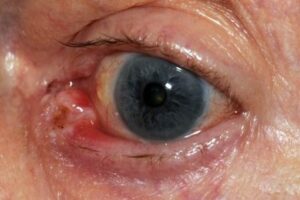
The face contains the eyes, nose, lips, ears and other structures where even relatively small defects can affect function and appearance.
Reconstruction therefore needs to consider:
Facial symmetry
Skin colour and texture
Natural contours
Eyelid function
Nasal function
Lip movement
Scarring
The aim is to restore both appearance and function where possible.
Basal Cell Carcinoma
Basal cell carcinoma is the most common form of skin cancer.
It commonly occurs on sun-exposed areas and can appear as a persistent lesion, pearly lump, ulcer or sore that does not heal.
Read more about basal cell carcinoma treatment in Auckland.
Squamous Cell Carcinoma
Squamous cell carcinoma is another common form of skin cancer and has a greater potential to spread than basal cell carcinoma.
Treatment depends on the individual cancer and may include surgical excision.
Read more about squamous cell carcinoma surgery.
Melanoma
Melanoma develops from melanocytes, the cells responsible for producing melanin.
It is less common than BCC and SCC but has a greater potential to spread.
Read more about melanoma surgery in Auckland.
Follow-Up After Skin Cancer Treatment
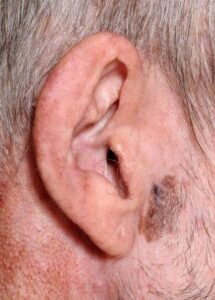
Follow-up is important because some skin cancers can recur and patients who have developed one skin cancer may be at increased risk of developing others.
The appropriate follow-up schedule depends on the type and stage of the cancer.
Frequently Asked Questions
What is the most common type of skin cancer?
Basal cell carcinoma is the most common type of skin cancer.
Does every skin cancer require surgery?
No. Treatment depends on the type, size, location and characteristics of the cancer. Surgery is an important treatment for many skin cancers, but other approaches may be appropriate in selected cases.Other treatment techniques include Mohs surgery, topical chemotherapy, immune response modifiers, cryotherapy (freezing the cancer), photodynamic therapy, and electrodesiccation and curettage.The goal of reconstructive surgery is restoration of normal appearance and function. Some of these techniques are indicated only for specific types of skin cancer. Mr Stanley Loo will discuss the best option for you in the consultation
Will skin cancer removal leave a scar?
Any surgical incision can leave a scar. The final appearance depends on the size and location of the defect, the reconstruction and individual healing.
Can a plastic surgeon remove skin cancer?
A specialist plastic surgeon can provide skin cancer excision and reconstruction, particularly where removal may create a significant functional or aesthetic defect.
What happens after skin cancer removal?
The tissue may be sent for pathological examination. Further treatment or follow-up depends on the diagnosis and characteristics of the cancer.
Book a Skin Cancer Consultation
If you have a changing, bleeding or non-healing skin lesion, appropriate medical assessment should not be delayed.
Stanley Loo provides specialist plastic surgery assessment and treatment for skin cancer and reconstruction in Auckland.
If you would like to discuss this further a consultation can be made with Mr Stanley Loo at Auckland Plastic Surgery Group, Unit 6 / 31 Highbrook Drive, Highbrook, Auckland 2013 Ph (09) 220 2580
Blogs
When Should a Skin Lesion Be Removed Safely?
Best Options for Skin Lesion Removal Explained
Skin Cancer Surgery: What to Expect
What to Expect From Skin Cancer Excision Procedure
Are Skin Biopsies Painful? What to Expect
How to Prepare for Lesion Excision Safely