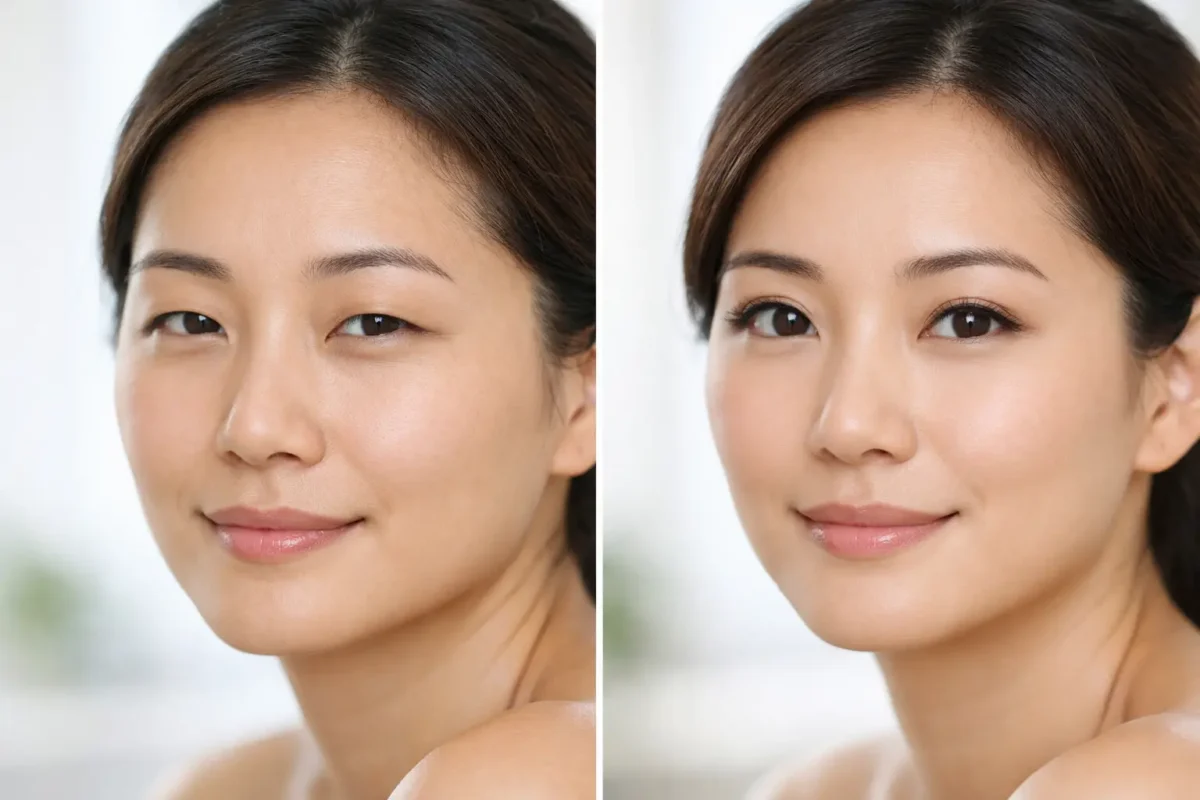
A good set of asian blepharoplasty before and after photos should do more than show a crease. They should show balance, symmetry, and an eyelid shape that still looks like you. For many patients, that is the real question – not whether the eyes look different, but whether the result looks natural, comfortable, and in keeping with their facial features.
Asian blepharoplasty is a highly individual procedure. It is designed to create or refine an upper eyelid crease while respecting the natural anatomy of the eyelid, brow, and surrounding tissues. The aim is not to make the eyes look rounder or more Western. A well-planned result should preserve ethnic identity and suit the patient’s own proportions.
What asian blepharoplasty before and after really shows
Before and after images can be useful, but only if they are interpreted carefully. Lighting, facial expression, swelling, and even make-up can change how results appear. More importantly, two patients may request a similar change and still need very different surgical plans.
In the before stage, the surgeon is assessing far more than whether a natural crease is present. Skin thickness, fat volume, levator function, asymmetry, brow position, and the height of any existing fold all matter. Some patients have no visible supratarsal crease. Others have a low or uneven crease, excess fullness, or an eyelid shape that makes eye make-up difficult to apply evenly.
In the after stage, the most successful result is often the one that does not look obviously operated on. The crease should be appropriately placed, the eyes should open comfortably, and the eyelids should remain harmonious with the rest of the face. A very high crease may look striking in a photo, but it can also appear unnatural on the individual. This is where experience and restraint matter.
Why results vary from person to person
There is no single “ideal” asian blepharoplasty result. Preferences differ, and anatomy differs even more. Some patients want a very subtle change that gives a more defined eyelid platform. Others prefer a slightly more visible crease to improve make-up application or reduce a heavy, puffy appearance.
The starting anatomy influences what is possible. A patient with thicker upper eyelid skin and fuller preaponeurotic fat may need a different technique from someone with a naturally fine eyelid and a faint existing crease. If there is asymmetry before surgery, improvement is realistic, but perfect mirror-image symmetry is not always achievable. Honest discussion about this is part of safe surgical planning.
Age also plays a role. Younger patients may seek crease formation alone, while older patients may have additional concerns such as skin redundancy, drooping, or brow descent. In those cases, the “after” result may depend on whether the plan includes skin excision, ptosis correction, or a more conservative approach to avoid an overdone appearance.
Surgical technique matters
Asian blepharoplasty is not one operation performed the same way every time. The technique is chosen according to anatomy, goals, and tissue characteristics.
For some patients, a suture-based method may be appropriate. This can suit carefully selected individuals with thin skin, minimal excess tissue, and a desire for a less invasive approach. The recovery may be quicker, but the fold may also be less durable in some cases.
For others, an incisional technique is more suitable. This allows more precise crease creation and, where needed, adjustment of skin, muscle, or fat. It is often the better option when there is significant fullness, asymmetry, or a need for long-term definition. That does not mean it should be aggressive. Removing too much tissue can create a hollow or tight-looking eyelid, which is difficult to reverse.
A thoughtful surgeon will explain why one method is recommended over another. The best technique is not the one that sounds simplest. It is the one that gives the safest route to a stable, natural result.
The first few weeks after surgery
Patients are often surprised by how different early recovery looks from final healing. Immediately after surgery, the eyelids are usually swollen. There may be bruising, mild tightness, and some asymmetry while the tissues settle. This is normal.
In the first week or two, the crease can look higher, deeper, or more pronounced than expected. That does not mean the final result will stay that way. Swelling can distort the shape temporarily, and each eyelid may settle at a slightly different pace. This is one reason early before and after comparisons can be misleading.
Most patients start to look more presentable within a few weeks, but refinement continues beyond that point. The scar line generally fades over time, and the crease softens as healing progresses. Final results often take several months to declare themselves fully.
Careful aftercare matters here. Following wound care instructions, sleeping with the head elevated, using cold compresses as directed, and avoiding activities that increase swelling can all support recovery. Just as important is attending follow-up appointments so healing can be monitored properly.
What makes a result look natural
A natural result is usually defined by proportion, not by how visible the crease is. The height of the fold should suit the patient’s anatomy. The shape should flow with the lash line and upper eyelid contour. The eyelid should still look soft.
The after result should also fit the patient’s broader facial features. A crease that is too high or too sharply carved may draw attention to the surgery rather than the face itself. In contrast, a lower, well-designed fold often gives the eyes more definition without changing the person’s character.
This is especially important for patients who want improvement without looking dramatically altered. Many are not seeking a completely new appearance. They want to look fresher, less puffy, or more balanced. In those cases, subtle surgery is often the most effective surgery.
Questions to ask when reviewing before and after photos
Photos are helpful, but they should never replace consultation. When you review asian blepharoplasty before and after examples, ask whether the patients shown have anatomy similar to your own. A result that looks excellent on one face may not suit another.
It is also worth asking how long after surgery the photos were taken. Early images may still show swelling. Late images give a better sense of scar maturation and crease stability.
You should also look beyond the fold itself. Do the eyelids look balanced? Is there any sign of hollowness, excessive tightness, or visible scarring? Does the result appear elegant and believable at rest, rather than simply dramatic in a posed image? These details often tell you more than the headline change.
The consultation is where the real planning happens
A careful consultation is the safest way to understand what your own before and after might look like. This is where your goals, anatomy, and expectations can be assessed properly. It is also where concerns about recovery, scarring, asymmetry, and longevity should be discussed openly.
For first-time surgery patients, this conversation is often reassuring. Good surgical care is not about persuasion. It is about making sure you understand the likely outcome, the limitations, and the recovery process before making a decision.
At a specialist practice such as Stanley Loo’s, that means consultant-led assessment, a personalised operative plan, and clear post-operative guidance. For a procedure as nuanced as asian blepharoplasty, that level of detail matters.
Setting realistic expectations
The best before and after results usually come from realistic expectations rather than dramatic promises. Surgery can improve crease definition, eyelid contour, and symmetry, but it cannot make two eyelids mathematically identical or stop the normal ageing process.
It is also worth remembering that your own perception may change during recovery. In the early stages, patients often focus on small differences that settle with time. Patience is part of the process. A calm, measured review over several weeks and months is far more useful than judging the result too soon.
Choosing surgery for the right reasons matters as well. If your goal is to feel more confident in your appearance, improve make-up application, or address a long-standing concern about eyelid shape, the procedure can be very rewarding. If your aim is to copy someone else’s eyes exactly, the conversation needs more care.
Asian blepharoplasty can produce refined, elegant change when it is based on your anatomy rather than a generic template. The most meaningful before and after is the one that leaves you looking rested, balanced, and recognisably yourself.