A flatter abdomen can be surprisingly difficult to achieve with diet and exercise alone. For many patients, the real question is not whether they have worked hard enough, but whether a tummy tuck or liposuction is the more suitable procedure for the concern they actually have.
Although these operations are often mentioned together, they address different problems. Choosing well starts with understanding what is causing the abdominal shape you want to change – excess fat, loose skin, stretched muscles, or a combination of all three. This is where a careful surgical assessment matters, because the right procedure depends less on what sounds simpler and more on what will give a safe, proportionate, and lasting result.
Tummy tuck or liposuction – what is the difference?
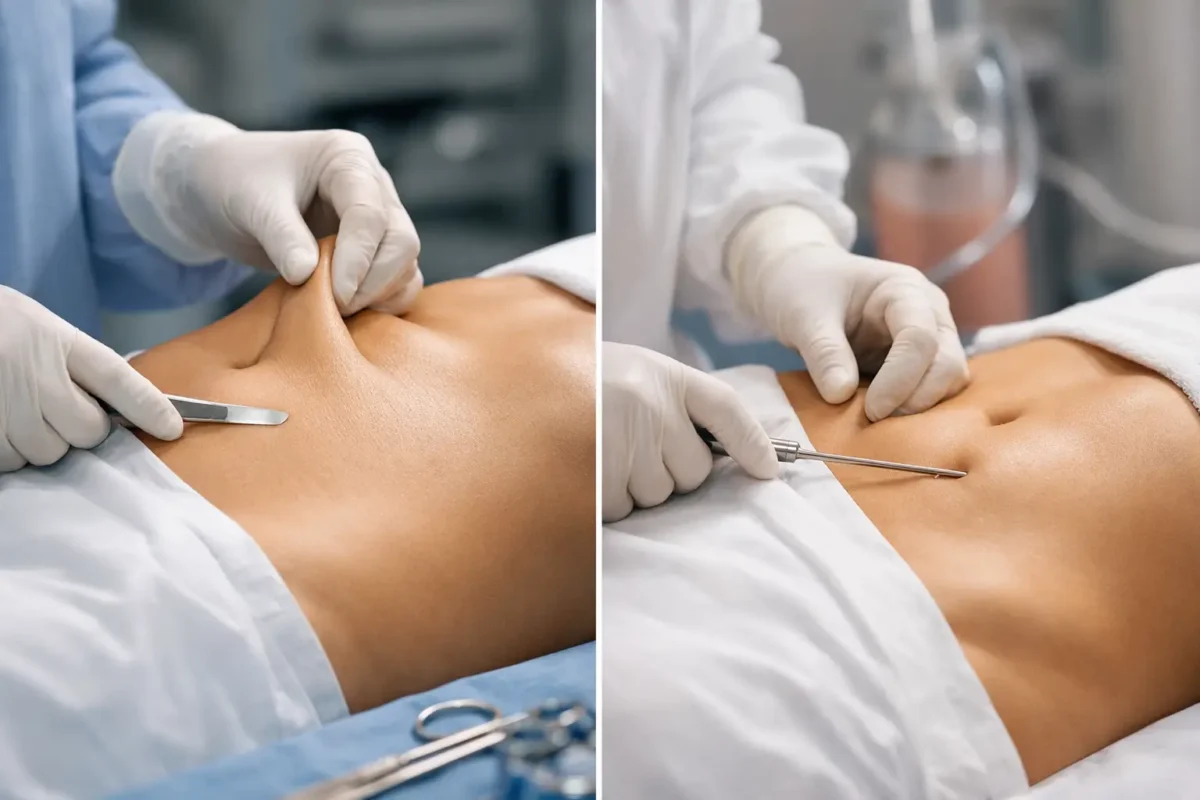
Liposuction removes localised fat deposits. It is best suited to patients whose skin still has reasonable elasticity and whose main concern is fullness or contour rather than skin laxity. In the abdominal area, liposuction can improve shape by reducing stubborn fat that has not responded to weight loss efforts.
A tummy tuck, also called abdominoplasty, is a more comprehensive operation. It removes excess skin and fat from the lower abdomen and can also repair separated abdominal muscles, a condition known as rectus diastasis. This is particularly relevant after pregnancy or major weight change, when the abdominal wall may feel weak or look prominent even in otherwise slim patients.
So when patients ask about tummy tuck or liposuction, they are often really asking which issue is dominant. If the problem is mainly fat, liposuction may be enough. If there is loose skin, muscle separation, or a hanging lower abdominal apron, a tummy tuck is usually the more appropriate option.
When liposuction may be the better choice
Liposuction is not a weight-loss operation. It is a contouring procedure for people who are close to a stable, healthy weight but have areas of persistent fat. In the abdomen, that might mean a soft fullness below the navel, fullness at the waist, or fat around the flanks that affects body shape.
The best candidates tend to have firm, elastic skin that can contract after the fat is removed. Younger patients often fall into this group, but age is not the deciding factor. Skin quality, body composition, and medical history are more important than age alone.
Recovery after liposuction is generally shorter and easier than after a tummy tuck, although it is still surgery and should not be treated lightly. Swelling, bruising, compression garments, and a few weeks of restricted activity are all part of the process. Final contour takes time to settle.
Liposuction can be an excellent choice when the abdomen is full but the skin is not significantly loose. It is less helpful if the skin has stretch marks, wrinkling, or obvious overhang, because removing fat without addressing the skin can sometimes make laxity more noticeable.
When a tummy tuck may be the better choice
A tummy tuck is usually recommended when the abdomen has changed in ways liposuction cannot correct. This often includes loose or excess skin after pregnancy, skin that remains after substantial weight loss, or bulging caused by separated abdominal muscles.
In these cases, simply removing fat will not create a firmer or flatter result. If the abdominal wall is stretched and the skin does not recoil, the contour problem is structural as much as fatty. A tummy tuck addresses this by tightening the internal support and removing surplus tissue.
Patients often notice additional benefits beyond appearance. When muscle repair is part of the procedure, some feel better core support and improved clothing fit. That said, this is still a significant operation with a longer scar, more recovery time, and more limitations in the early post-operative period.
A tummy tuck is not the right choice for everyone. Patients planning future pregnancies or still actively losing weight are often better served by waiting, as these changes can affect the surgical result.
Can tummy tuck and liposuction be combined?
Yes, in many cases they can. This is common because abdominal contour concerns rarely fall into neat categories. A patient may have loose lower abdominal skin as well as excess fat across the upper abdomen or flanks. In that situation, combining procedures may produce a more balanced result than either one alone.
A combined approach must be planned carefully. Safety comes first, and the decision depends on overall health, body mass index, tissue quality, and the extent of surgery needed. A specialist consultation is important to decide whether combination treatment is appropriate and how to achieve a proportionate result without taking unnecessary risks.
What results can you realistically expect?
Both procedures can improve abdominal shape, but neither creates perfection. Liposuction can slim and refine contour, though it cannot tighten muscles or remove significant loose skin. A tummy tuck can flatten and firm the lower abdomen more dramatically, but it involves a scar and a more involved recovery.
Good results also depend on stable weight and realistic expectations. Surgery can improve contour, but it does not stop future weight gain, ageing, or changes related to lifestyle and hormones. Patients who do best are usually those seeking improvement rather than an idealised outcome.
Photographs shown in consultation can be helpful, but they should be used carefully. Another person’s body shape, skin quality, and healing pattern may be quite different from your own.
Recovery differences to consider
This is often where the choice becomes clearer. Liposuction usually involves less downtime. Most patients can return to light daily activity relatively quickly, although swelling can persist for weeks and final definition may take several months to emerge.
A tummy tuck recovery is more demanding. Patients usually need more time away from work, more help at home in the first days, and more patience while standing fully upright becomes comfortable again. If muscle repair is performed, lifting restrictions are especially important.
Neither option should be chosen simply because it sounds easier. The best procedure is the one that treats the underlying problem properly. A shorter recovery is not an advantage if it leads to an incomplete result.
Scars, safety, and long-term planning
Liposuction uses small access points, so scarring is usually limited and discreet. A tummy tuck leaves a longer lower abdominal scar, typically positioned to sit beneath most underwear or swimwear, but the exact placement and length depend on the anatomy being treated.
All surgery carries risk. These include bleeding, infection, seroma, delayed healing, asymmetry, contour irregularity, and complications related to anaesthesia. With tummy tuck surgery, there is also the added consideration of muscle repair, wound healing tension, and a longer recovery period.
A thorough pre-operative assessment helps reduce risk by identifying whether surgery is suitable at all, what preparation is needed, and whether expectations align with what can safely be achieved. In a specialist-led practice such as Stanley Loo’s, patient education is not separate from treatment – it is part of treatment.
How to decide between tummy tuck or liposuction
The most useful question is not which procedure is better. It is what your abdomen needs in order to improve. If your skin is firm and your concern is localised fat, liposuction may be enough. If your skin is loose, your lower abdomen overhangs, or your muscles have separated, a tummy tuck is more likely to give the result you are hoping for.
Sometimes patients ask whether they can try liposuction first and avoid a tummy tuck. In selected cases that may be reasonable, but if skin laxity is already obvious, it can lead to disappointment. Equally, not everyone with abdominal fullness needs a tummy tuck. Recommending more surgery than necessary is no better than recommending too little.
That is why an in-person consultation matters. Examination of the skin, pinch thickness of fat, abdominal wall tone, scar history, previous pregnancies, and general health all contribute to the decision. A careful surgeon should explain not only what each procedure can do, but also what it cannot do.
If you are weighing up tummy tuck or liposuction, it helps to think beyond the operation itself. Consider your recovery capacity, family and work commitments, scar tolerance, and whether your weight has been stable for long enough to make surgery worthwhile. The right answer is usually the one that fits both your anatomy and your life, not just your wish list.
A well-chosen procedure should leave you feeling that the decision was clear once the right information was in front of you. That clarity, supported by honest advice and careful follow-up, is often the best place to begin.