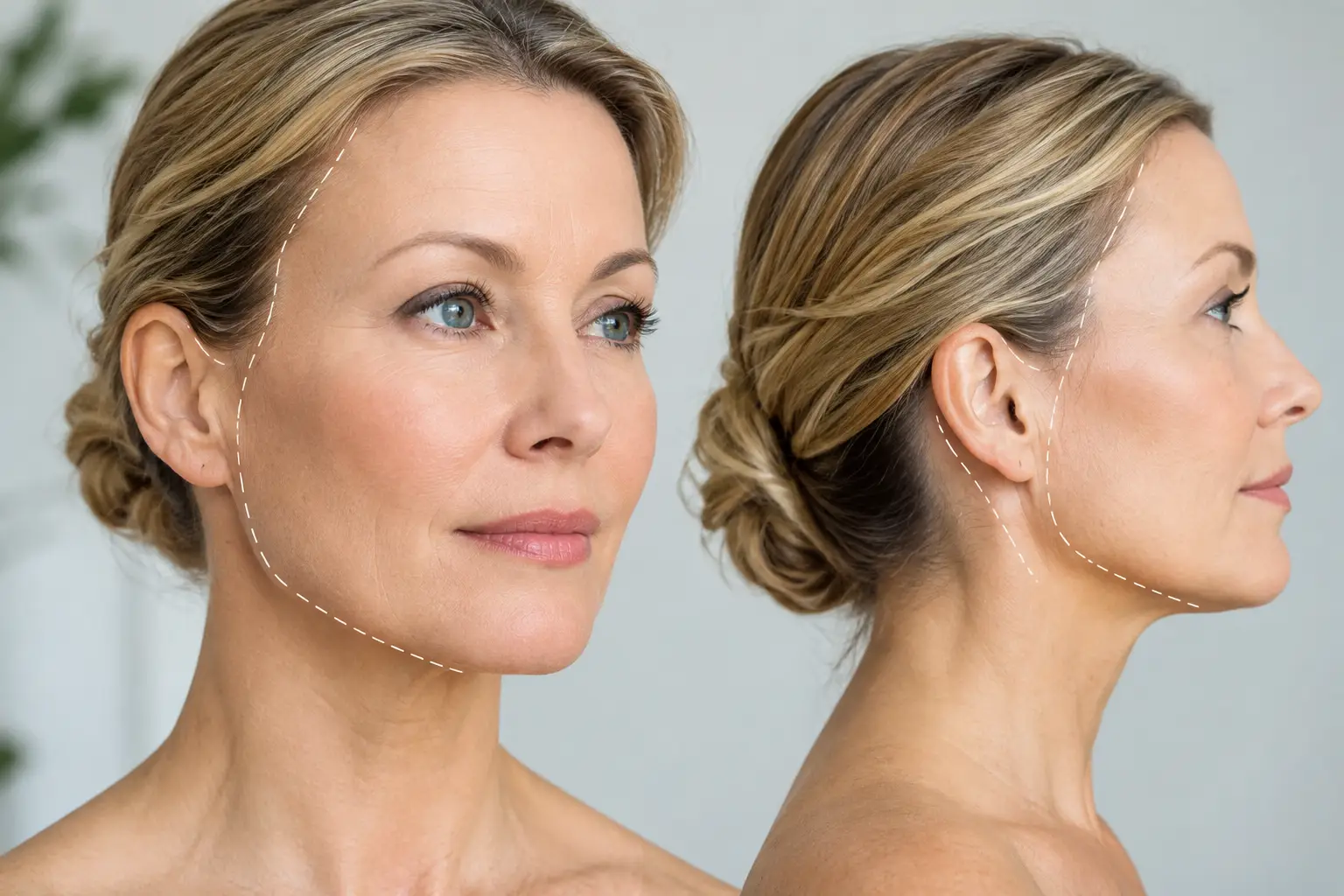
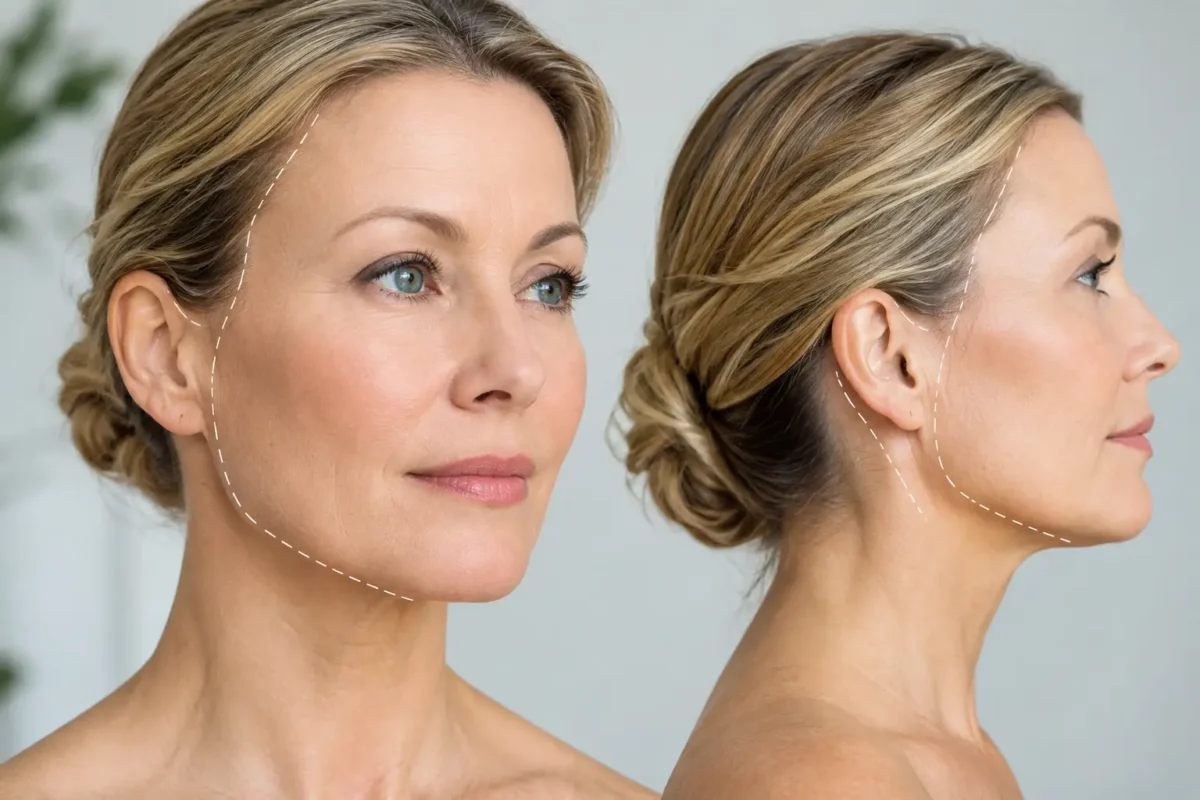
A facelift is designed to refresh the face, not to advertise that surgery has taken place. That is why facelift scar placement is discussed carefully before an operation: the position of each incision influences both surgical access and how discreetly the scar may settle over time. A well-planned scar is usually concealed within natural facial contours, hair-bearing skin and the folds around the ear, but no incision can be made completely scar-free.
The right approach is individual. Facial anatomy, hairline height, skin quality, degree of laxity, previous surgery and the type of lift required all affect where incisions are placed. A consultation is the time to understand these choices, including the benefits, limits and recovery involved.
Why facelift scar placement matters
A facelift, also called a rhytidectomy, addresses laxity in the lower face and neck by lifting and repositioning deeper tissues, removing or redistributing excess skin where appropriate, and refining the jawline and neck contour. The surgeon needs incisions that provide safe, precise access to these structures.
Placing an incision only where it is easiest to hide is not always the best surgical decision. If access is too limited for the amount of correction needed, tension may be placed on the skin closure or the result may be less durable. Conversely, a longer incision may be appropriate when there is significant neck skin excess or a need to improve the contour beneath the chin. The aim is to balance effective lifting with the least conspicuous scar pattern that safely suits the procedure.
Scars are most noticeable early in recovery. They are often pink, firm or mildly raised while the body remodels collagen, then usually soften and fade gradually. This maturation process commonly continues for 12 months or longer.
Common facelift incision locations
In front of the ear
For many facelifts, the incision begins within the natural crease where the ear meets the face, known as the preauricular crease. It may follow the contour in front of the ear and around the small cartilage prominence at the front of the ear canal. Using this natural junction helps break up the line of the scar rather than placing it across a broad, flat area of cheek skin.
Careful closure matters as much as incision design. The skin should be redraped without undue tension, as tension can widen a scar or subtly distort the earlobe and hairline.
Around and behind the ear
The incision often continues around the lower ear and into the crease behind it. This allows the surgeon to address skin laxity through the jawline and upper neck. When necessary, it may extend into the hair-bearing scalp behind the ear, where it can be concealed by the hair once healing has progressed.
An incision behind the ear is particularly common when a neck lift is performed alongside the facelift. The amount of extension depends on the degree of loose neck skin, tissue quality and the planned surgical technique. Patients with short hair or who regularly wear their hair up should mention this during consultation, as it can be considered when discussing scar visibility and placement.
Along the hairline or within the scalp
Some procedures require an incision that extends into the temple or scalp. The precise position is planned with particular attention to the hairline. For patients with a high hairline, thinning hair or a history of hair loss, this conversation is especially important.
A surgeon may choose a hairline-based incision, an incision set slightly within the hair-bearing scalp, or another variation based on the anatomy and goals of the operation. Each option involves a trade-off. An incision within the scalp can be well hidden, but skin movement must not create an unnatural shift in the sideburn or temporal hairline. A hairline incision may preserve hair-bearing skin positioning but can be more visible during the earlier stages of healing.
Beneath the chin
A small incision in the natural crease beneath the chin may be used when the neck needs additional contouring. It can provide access for treating the platysma muscle, removing localised fat where appropriate, or improving the angle between the chin and neck.
Not every facelift requires this incision. In a patient with good neck definition and limited laxity, it may add little benefit. In others, particularly where there is muscle banding or fullness below the chin, it can be an important part of achieving a balanced result.
What changes the scar plan?
There is no single facelift pattern that is right for every face. A limited or short-scar facelift may be suitable for someone with early jowl formation and modest skin laxity. It may involve shorter incisions around the ear, but it cannot reliably correct substantial neck looseness or extensive excess skin.
A more comprehensive facelift and neck lift may require incisions that extend further behind the ear or into the scalp. This can provide better access and reduce closure tension, which may support a more natural contour. The trade-off is a larger scar footprint, although much of it is placed in less visible areas.
Previous facelift surgery, facial scars, radiation treatment, smoking history, tendency to form thick scars and certain medical conditions also require careful consideration. Previous scars may sometimes be incorporated or revised, but scar behaviour cannot be predicted with certainty. A specialist assessment helps identify factors that could affect healing and whether surgery should be adapted, delayed or avoided.
How facelift scars heal
Immediately after surgery, incisions are covered with dressings and the face may feel tight or swollen. Bruising and swelling can temporarily make the scar area appear more obvious than it will later. The early healing period requires patience and close adherence to post-operative instructions.
Once the incisions have sealed, scars may become redder or firmer before they improve. This is a normal part of healing for many patients, rather than a sign that the final result will be poor. However, increasing pain, spreading redness, discharge, fever, wound separation or a sudden change in swelling should be reported promptly to the surgical team.
Skin type and individual biology play a role. Some people naturally develop darker pigmentation after inflammation, while others are prone to raised or widened scars. These risks should be discussed openly before surgery, particularly if you have had problematic scars in the past.
Supporting the best possible scar outcome
Your surgeon and nursing team will provide individual aftercare instructions, including when to wash the area, how to manage dressings and when to return for review. Following these instructions is one of the most practical ways to support healing.
Avoid nicotine in all forms before and after surgery, as it reduces blood flow and can significantly increase the risk of wound-healing problems. Protecting healing scars from sunlight is also important. UV exposure can make scars darker and more persistent, so use the recommended sun protection once the wound has healed sufficiently and keep the area covered where practical.
Do not start silicone products, massage or topical treatments until your surgeon confirms they are appropriate. These measures can be useful for some scars, but timing matters. Similarly, avoid vigorous exercise, heavy lifting and activities that raise blood pressure until you have been cleared to resume them. Early strain can increase swelling and place stress on healing incisions.
Questions worth asking at consultation
A meaningful consultation should include more than a discussion of before-and-after photographs. Ask where your incisions are likely to sit, whether they may extend into the hairline or beneath the chin, and why that approach is recommended for you. It is also reasonable to ask how your hairstyle, hairline, skin quality and previous scars influence the plan.
Your surgeon should explain what improvement is realistic, what scars can and cannot be hidden, and how follow-up care will be organised. A reassuring answer is not one that promises invisible scars. It is one that explains the surgical reasoning clearly and makes space for informed decisions.
The best time to raise concerns about facelift scars is before surgery, when the plan can be tailored to your anatomy and priorities. With thoughtful placement, meticulous technique and attentive aftercare, scars typically become a quieter part of the result rather than the feature you notice first.