
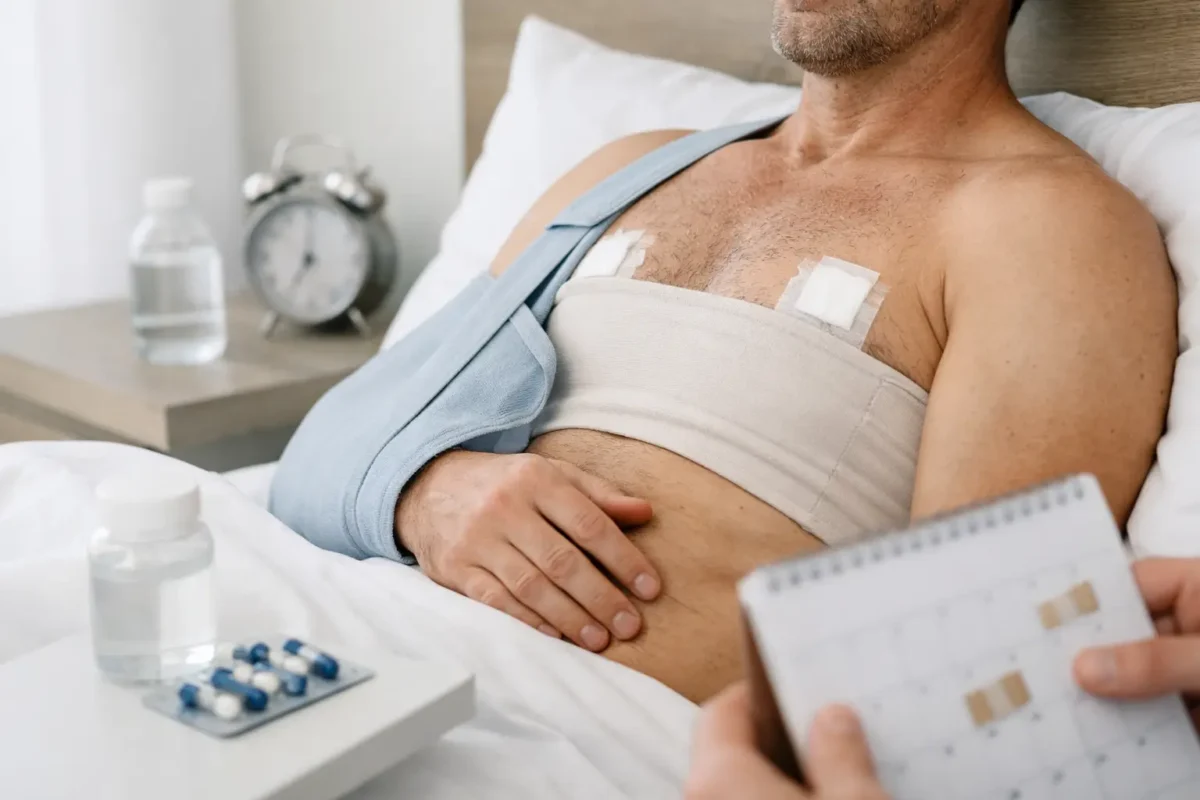
Most men asking about gynaecomastia surgery are not only thinking about the operation itself. They want to know when they can get back to work, when the swelling settles, whether the chest will look natural, and how uncomfortable recovery is likely to be. Gynaecomastia surgery recovery is a gradual process rather than a single moment, and knowing what to expect can make the experience feel far more manageable.
Recovery varies from patient to patient because the procedure itself varies. Some men need liposuction alone, while others need gland removal, skin tightening, or a combination of techniques. Your starting anatomy, skin quality, general health, and the extent of surgery all influence how quickly you feel back to normal. That said, there are typical stages most patients move through.
What to expect after gynaecomastia surgery recovery begins
Immediately after surgery, it is normal to feel tightness across the chest, mild to moderate discomfort, and some grogginess from the anaesthetic. The chest usually looks swollen at first, and that early appearance is not the final result. Bruising, tenderness, and a sense of pressure are common in the first few days.
A compression garment is often an important part of the early recovery period. This helps reduce swelling, supports the tissues as they settle, and can improve comfort when moving around. It may feel unfamiliar at first, but most patients adjust to it quickly.
Drain usage depends on the surgical technique and the amount of tissue removed. If drains are used, they are usually temporary. Your surgeon will explain how long they are expected to stay in place and what level of drainage is considered normal.
It is also common for the chest to feel numb or patchy in sensation after surgery. This can be unsettling if you are not expecting it, but temporary numbness usually improves with time as the tissues recover.
The first week
The first week is focused on rest, light movement, and protecting the surgical area. Most patients are encouraged to walk gently around the house on the day of surgery or the following day, as this supports circulation and reduces the risk of complications associated with prolonged immobility. At the same time, the chest should not be strained.
During this period, discomfort is usually most noticeable in the first few days and then starts to ease. Pain is often described as soreness, tightness, or stiffness rather than severe pain. Prescribed or recommended pain relief is usually enough to keep symptoms under control.
Swelling and bruising tend to peak early. One side may appear more swollen than the other, and that does not always mean anything is wrong. Human bodies are not perfectly symmetrical, and healing is not either. A small degree of asymmetry early on is common.
Most patients will need time away from gym training, lifting, and strenuous activity. Depending on the nature of your work, you may be able to return to desk-based duties within several days, but physically demanding jobs usually require longer. If your role involves lifting, reaching, manual labour, or a lot of upper body movement, it is sensible to plan more recovery time.
Weeks two to four
By the second and third week, many men feel more comfortable and mobile. Bruising often starts to fade significantly, although residual swelling usually remains. This is the stage where patients sometimes expect the chest to look nearly finished, but healing is still very much underway.
The tissues beneath the skin may feel firm, lumpy, or uneven. This is often part of the normal healing response. Internal swelling and scar tissue formation can create temporary irregularities, even when the long-term result is expected to be smooth. These changes often soften gradually over the following weeks and months.
You may be advised to continue wearing compression for a set period, often for several weeks. The exact duration depends on the procedure performed and your surgeon’s preference. Following that advice matters, because seemingly small details during recovery can influence comfort, swelling, and the way tissues settle.
Light daily activities are usually easier by this stage, but chest workouts, contact sports, swimming, and heavy lifting are generally still restricted. Rushing back too early can increase swelling and may affect healing.
When can you exercise again?
This is one of the most common questions in gynaecomastia surgery recovery, and the answer depends on the type of exercise. Gentle walking usually starts early. More vigorous cardiovascular exercise may be allowed sooner than upper body resistance training, but this varies.
Weight training, press-ups, heavy lifting, and high-impact activity normally need to wait until the chest is more secure and the tissues have had time to heal. If gland excision has been performed, there is often more internal healing required than patients realise. Feeling well is not always the same as being ready.
For men who train regularly, this can be frustrating. Even so, patience usually pays off. A short period of reduced activity is preferable to causing bleeding, prolonged swelling, or disruption to the healing tissues. Your surgeon will advise when it is safe to increase activity and in what stages.
Swelling, scar tissue and final shape
One of the more difficult parts of recovery is that improvement is not always linear. The chest may look better one week and more swollen the next, particularly after increased movement or activity. This can be normal.
Swelling often settles in stages. The early reduction can be quite noticeable, but low-level swelling may persist for longer than expected. Final contour can take several months to declare itself fully. Skin contraction also takes time, especially in patients who had more significant fullness beforehand.
Scar tissue can temporarily create firmness under the nipple or in the lower chest. This does not necessarily mean the gynaecomastia has returned. In many cases, it is simply part of healing. The distinction matters, which is why follow-up appointments are valuable. They allow your progress to be assessed properly rather than guessed at in the mirror.
Scars themselves are usually placed as discreetly as possible, often around the edge of the areola if gland tissue has been removed directly. Early scars may appear pink or firm before softening and fading. Scar quality depends on surgical technique, genetics, skin type, and aftercare, so there is some natural variation.
Warning signs that need review
Most recoveries are straightforward, but patients should know what deserves attention. Increasing rather than improving pain, rapidly expanding swelling, significant bleeding, fever, spreading redness, or unexpected discharge from the wound should be reported promptly.
A fluid collection or bleeding under the skin can sometimes occur after chest surgery. These issues are not common, but early review is important if they are suspected. Good post-operative communication matters here. Patients should feel they know who to contact and when.
Less urgent concerns, such as ongoing firmness, mild asymmetry, or slow fading of swelling, are often best discussed at routine follow-up. Not every irregularity is a complication, and many settle without intervention.
Practical tips for a smoother recovery
A smooth recovery is helped by good preparation. Arrange time away from strenuous work, have comfortable loose clothing ready, and set up a place to rest where getting in and out is easy. Sleeping slightly elevated can help some patients feel more comfortable in the first few days.
Avoid smoking and nicotine exposure, as these can impair healing. Keep to the advice given about showering, wound care, compression, and activity restrictions. If medication has been prescribed, take it exactly as directed. Small lapses can create avoidable setbacks.
It also helps to keep expectations realistic. Surgery can improve chest contour significantly, but the early post-operative period rarely looks polished. The best results tend to reveal themselves gradually, not overnight.
The emotional side of recovery
Physical recovery gets most of the attention, but emotional adjustment matters too. Many men have lived with chest self-consciousness for years before seeking treatment. It is common to feel relief after surgery, but also moments of worry during the healing phase, particularly when swelling or unevenness temporarily disguises the result.
This is where clear guidance and proper follow-up make a real difference. An experienced specialist team will explain what is normal, what is not, and when patience is the right approach. In a consultant-led practice such as Stanley Loo’s, recovery is not treated as an afterthought. It is part of the procedure itself.
How long until you see the final result?
Most patients see meaningful improvement within the first few weeks, but final results usually take longer. A better outline in clothing may be noticeable fairly early, while the refined chest contour, softer tissues, and maturing scars continue to improve over several months.
If skin elasticity is good and the amount of tissue removed is modest, the chest may settle relatively quickly. If surgery was more extensive, or if the skin had been stretched for a long time, the process may be slower. Neither scenario is automatically better or worse. They are simply different patterns of healing.
The most useful mindset is to think of recovery as a series of milestones rather than a deadline. Early healing is about comfort and safety. The next stage is about swelling settling and confidence returning. The final stage is about the chest taking on its longer-term shape. Give your body that time, and judge progress over months rather than days.