
Categories
Skin Cancer

What to Expect From Skin Cancer Excision Procedure

https://plasticsurgerynz.org/skin-cancer-excision-procedure/
July 13, 2026 - Stanley Loo -A suspicious spot can create understandable uncertainty,

A suspicious spot can create understandable uncertainty, particularly when a biopsy has confirmed skin cancer or your doctor has recommended removal. A skin cancer excision procedure is designed to remove the diagnosed lesion along with a planned margin of surrounding tissue, then send the specimen for laboratory assessment. The aim is complete treatment while preserving function, comfort and the best achievable scar.

Excision is a common and highly effective treatment for many skin cancers. However, the right approach depends on the type of cancer, its size and depth, its location, whether it has been treated before, and your individual health. A careful consultation gives you the opportunity to understand what is proposed and why.

Why excision may be recommended

Skin cancer excision is most commonly used for basal cell carcinoma, squamous cell carcinoma and melanoma. These cancers behave differently. Basal cell carcinomas usually grow locally and rarely spread elsewhere, but can cause significant local damage if left untreated. Squamous cell carcinomas have a greater potential to spread, particularly when they are large, deep, recurrent or located in higher-risk areas. Melanoma requires prompt, specialist-led assessment because its behaviour is closely related to the depth of the lesion.

In some circumstances, a biopsy has already established the diagnosis. In others, the entire lesion is removed because this is the most reliable way to diagnose and treat it. Non-surgical treatments may be suitable for selected superficial lesions, but excision has an important advantage: it provides tissue for pathology and allows the doctor to assess whether the cancer has been removed with clear margins.

The face, ears, scalp, hands, lower legs and areas close to the eyes, nose or lips need particular consideration. In these locations, surgical planning is about more than removing cancer. It must also protect important structures and achieve a wound closure that heals as well as possible.

Your consultation and surgical planning

Before surgery, your specialist will examine the lesion and review any biopsy or pathology report. They will discuss your medical history, medications, allergies, smoking status and previous scars or skin cancer treatment. Blood-thinning medication should never be stopped without advice from the clinician who prescribed it, but it may affect the timing and preparation for surgery.

The discussion should cover the expected scar, possible reconstruction, the type of anaesthetic, recovery, and the small but real risks of bleeding, infection, wound separation, altered sensation and an unfavourable scar. Most excisions are performed under local anaesthetic, meaning the area is numbed while you remain awake. Larger procedures, complex reconstructions or patient preference may mean sedation or a general anaesthetic is considered.

A margin is the rim of normal-looking skin removed around the visible lesion. It is not chosen arbitrarily. Recommended margins vary according to the diagnosis and risk features. A lesion with indistinct edges, a recurrent cancer or a melanoma may need a wider excision than a small, well-defined low-risk basal cell carcinoma. Your surgeon will balance oncological safety with the practical need to close or reconstruct the wound.

Planning the closure

A small wound can often be closed directly with stitches. If removing the lesion leaves too much tension, a skin graft or local flap may be recommended. A flap uses nearby skin and tissue, moved carefully while retaining its blood supply. It can be particularly useful where colour, thickness and contour matter, such as the nose, cheek or ear.

This is one reason a specialist assessment can be valuable. The method of closure is planned before the first incision, not treated as an afterthought once the cancer has been removed.

What happens during the skin cancer excision procedure

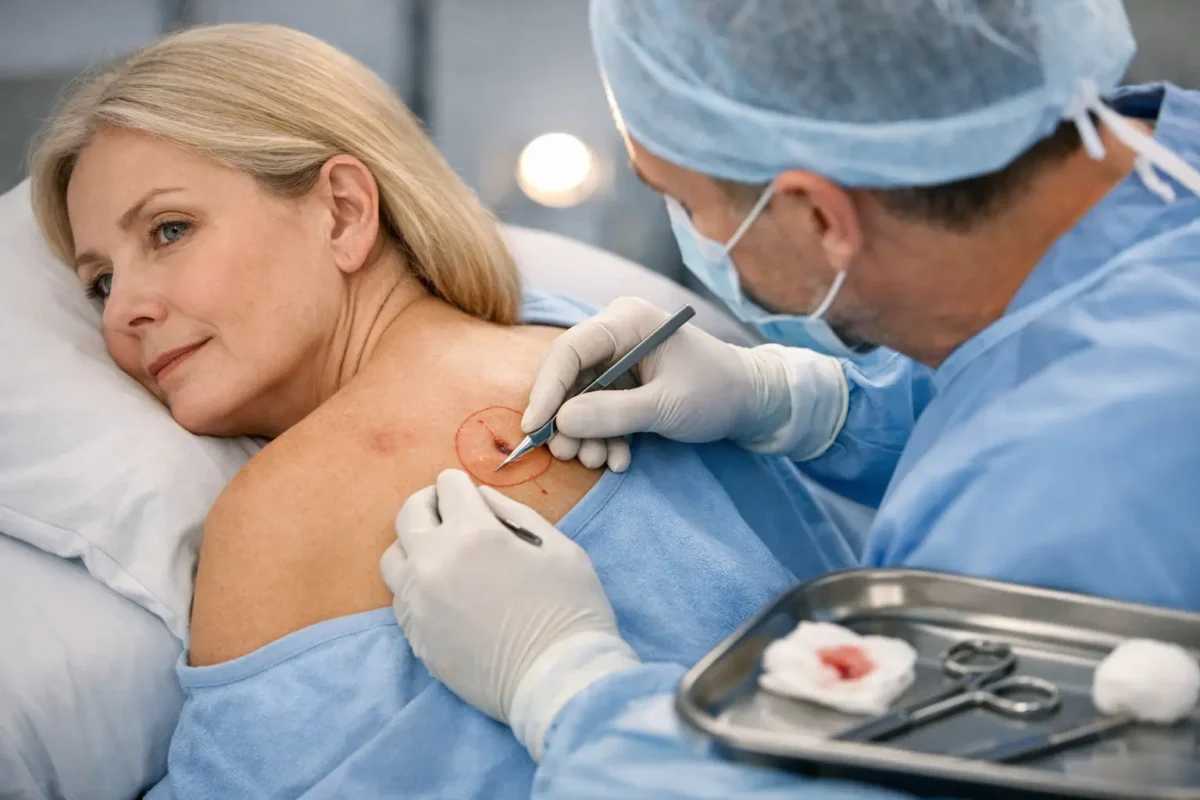
On the day, the lesion and planned margins are marked after confirming the site with you. This safety step is especially important if there are several lesions or if the area has become less visible after a biopsy.

For local anaesthetic surgery, you may feel a brief sting as the numbing medicine is injected. Once it has taken effect, you should feel pressure or movement but not sharp pain. Tell the surgical team immediately if you are uncomfortable. The skin is cleaned, sterile drapes are placed, and the lesion is removed with the intended margin of surrounding tissue.

The specimen is labelled and sent to a pathology laboratory. Depending on the wound and site, the surgeon may close the deeper layers with dissolving sutures and use fine stitches on the skin. A dressing is then applied. Straightforward procedures are often completed within an hour, although complex closures can take longer.

Occasionally, a planned direct closure is not appropriate once the true size of the defect is apparent. If this is a possibility, it should be discussed beforehand. Good surgical care includes having a clear plan while remaining prepared to make a safe adjustment if the findings require it.

Pathology results and clear margins

The laboratory examines the removed tissue under a microscope. The report confirms the diagnosis, describes relevant features of the cancer and comments on the excision margins. A clear margin means that no cancer is seen at the cut edge of the specimen. This is reassuring, although the meaning of a close margin can vary according to the cancer type and site.

If cancer cells extend to an edge, further treatment may be advised. This may involve a wider excision, a specialised margin-controlled technique, or occasionally radiotherapy or another treatment. It does not necessarily mean anything was done incorrectly. Some skin cancers have microscopic extensions beyond what can be seen on the surface, and pathology is the tool that identifies this.

Results are usually discussed at follow-up or communicated once they are available. Ask when and how you will receive your result before leaving the clinic. Waiting can be difficult, and knowing the next step often makes the period more manageable.

Looking after your wound

Your post-operative instructions will reflect the location and type of closure. Keep the dressing clean and dry for the period advised. After that, gentle washing may be appropriate, but avoid rubbing the wound. Do not apply creams, ointments or antiseptics unless your surgical team has recommended them, as some products can irritate healing skin.

Swelling, bruising and mild discomfort are common in the first few days. Elevating the area where practical, avoiding strenuous activity, and using the pain relief advised by your clinician can help. Procedures on the face often look more noticeable before they look better, and bruising may take one to two weeks to settle.

Contact your surgical team if you develop increasing rather than improving pain, spreading redness, warmth, pus-like discharge, fever, persistent bleeding or a dressing that becomes saturated. These symptoms do not always indicate infection, but they deserve prompt advice.

Stitches are removed according to the site and closure. Facial sutures are commonly removed sooner than stitches on the trunk or limbs, where healing is slower and tension can be greater. The scar will continue to mature for many months. Once the wound is fully healed, protecting it from sun exposure and following scar-care advice can support a better long-term result.

Follow-up is part of treatment

Having one skin cancer increases the chance of developing another. Follow-up therefore includes both checking the surgical site and helping you develop a practical surveillance plan. The frequency of review depends on the diagnosis, pathology findings, number of previous skin cancers and your personal risk factors.

Between appointments, become familiar with your skin. Seek assessment for a sore that does not heal, a spot that bleeds repeatedly, a changing mole, or a new lesion that continues to grow. Sun protection matters too: use shade, protective clothing, a broad-brimmed hat and suitable sunscreen as part of a broader routine, rather than relying on sunscreen alone.

The most reassuring treatment plan is one that gives equal attention to cancer clearance, careful reconstruction and the support you receive afterwards. If you have been advised to have an excision, a consultation with a specialist surgeon can help you understand your options and approach the procedure with clarity.
Categories
Skin Cancer

Skin Cancer Surgery: What to Expect

https://plasticsurgerynz.org/skin-cancer-surgery-what-to-expect/
July 7, 2026 - Stanley Loo -A diagnosis of skin cancer can make even a straightforward

A diagnosis of skin cancer can make even a straightforward treatment plan feel overwhelming. For many patients, skin cancer surgery is the most effective way to remove the cancer, confirm clear margins, and protect both health and appearance as much as possible.

Surgery is not one single procedure. The right approach depends on the type of skin cancer, where it sits, how large or deep it is, and whether preserving nearby structures matters for function as well as appearance. A small lesion on the trunk is managed differently from a skin cancer on the nose, eyelid, lip or ear, where every millimetre counts.

When skin cancer surgery is recommended

Skin cancer surgery is commonly used for basal cell carcinoma, squamous cell carcinoma, and some early melanomas. In many cases, surgery offers the best chance of complete removal because the tissue can be sent to the laboratory and examined under the microscope. That pathology result helps confirm the diagnosis and shows whether the cancer has been fully excised.

For some lesions, surgery is clearly the first choice. This is often the case when the cancer has defined borders, is growing, has returned after previous treatment, or sits in an area where incomplete treatment could cause ongoing problems. Surgery may also be advised when a biopsy has already shown cancer and the next step is to remove the remaining abnormal tissue with an appropriate margin.

There are situations where alternatives may be discussed. Certain superficial lesions can sometimes be treated with topical therapy, cryotherapy, curettage, or radiotherapy. However, these options are not interchangeable in every case. They can be useful, but they may not provide the same certainty about complete removal, and some are less suitable for high-risk or recurrent skin cancers.

What happens before surgery

A careful assessment comes first. This includes examining the lesion, reviewing any biopsy result, discussing your medical history, and considering medications that may affect bleeding or healing. If the lesion is in a visible area, planning also includes how best to reconstruct the wound once the cancer has been removed.

This stage matters. Good skin cancer care is not simply about cutting out a lesion. It is about balancing oncological safety with wound healing, scarring, function, and long-term follow-up. On the face in particular, the reconstruction plan should be considered before surgery begins, not afterwards.

During consultation, patients often want to know how much skin will need to be removed. The honest answer is that it depends. Surgeons aim to remove enough tissue to treat the cancer properly while preserving as much normal tissue as possible. The recommended margin varies according to the diagnosis and the behaviour of the tumour.

Types of skin cancer surgery

The most common procedure is surgical excision. This involves removing the visible lesion together with a border of normal-looking skin. The wound may then be closed directly with stitches, or repaired using a skin flap or skin graft if the defect is larger or in a more complex area.

Direct closure is often possible for small lesions where the skin has enough laxity. This tends to be the simplest option and may produce a very acceptable scar, particularly when the incision can be placed in a natural skin line.

A local flap uses nearby skin and soft tissue to repair the area. This can be especially helpful on the face, where matching colour, texture and contour is important. A flap is often more technically involved than a straightforward closure, but it can give a better functional and cosmetic result in the right setting.

A skin graft uses skin taken from another site on the body to cover the wound. This may be recommended when there is not enough adjacent tissue to move safely into place. Grafts can be very effective, though they may differ slightly in colour or texture from the surrounding skin.

For some higher-risk or anatomically sensitive lesions, staged excision or margin-controlled surgery may be considered. The main goal is to ensure the cancer is fully removed while sparing as much healthy tissue as possible. This is particularly relevant around the eyelids, nose, ears and lips.

Anaesthetic and the day of the procedure

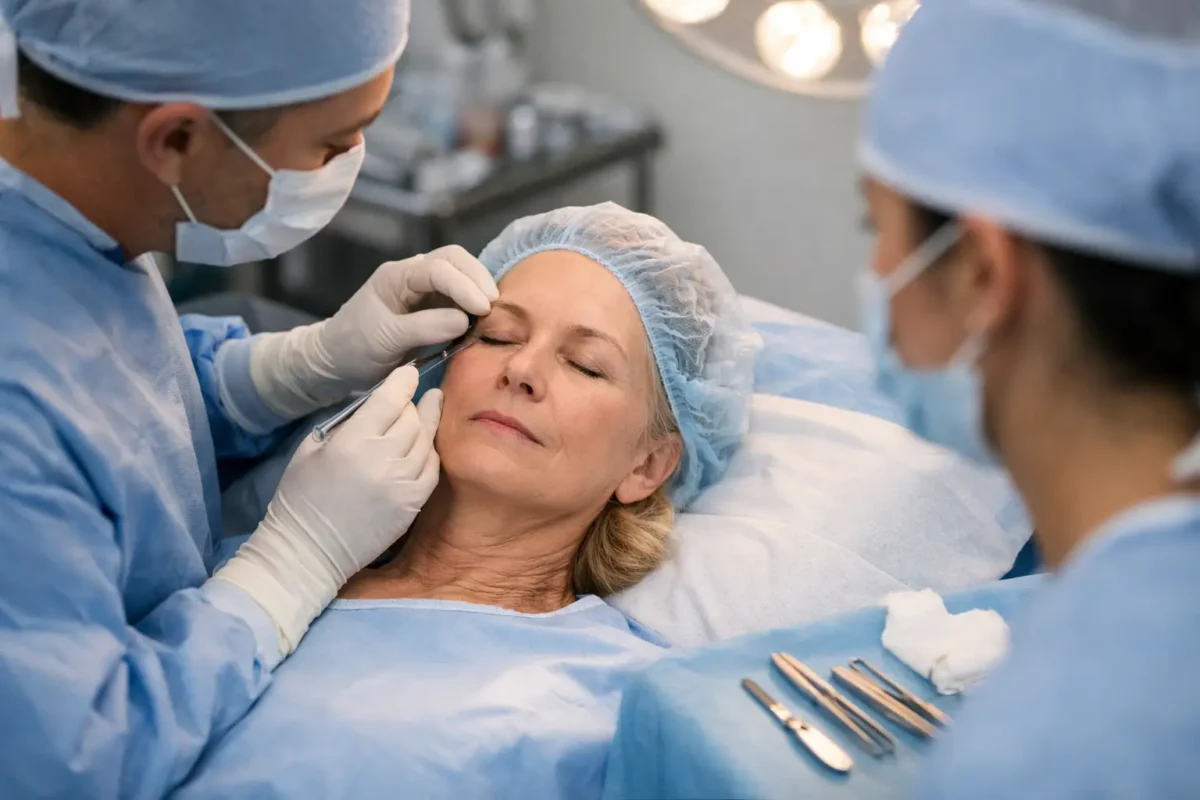
Many skin cancer procedures are performed under local anaesthetic. This means the area is numbed while you remain awake. Patients are often relieved to find that treatment is quicker and more manageable than they expected.

Larger lesions, more complex reconstructions, or patient-specific factors may make sedation or general anaesthetic more appropriate. That decision is based on the size and site of the surgery, your health, and what is likely to provide the safest and most comfortable experience.

On the day, the lesion is marked, the skin is prepared, and the planned procedure is carried out. The removed tissue is sent for pathological examination. You will also receive instructions about wound care, dressings, activity, and when to return for review.

Recovery after skin cancer surgery

Most patients recover well, but recovery is not identical for everyone. A small excision on the shoulder may settle quickly. A reconstruction on the nose or lower eyelid can involve more swelling, bruising and temporary tightness.

Mild discomfort is common and is usually manageable with simple pain relief. Swelling and bruising are often more noticeable in facial surgery and can take a couple of weeks to settle. If a skin graft or flap has been used, follow-up is particularly important so that healing can be monitored closely.

Stitches may be dissolvable or may need removal, depending on the site and technique used. Scar maturation takes time. Even when a wound looks neat early on, it can continue to soften and settle over several months.

Patients often ask when they can get back to normal activities. Again, it depends. Gentle day-to-day movement is usually fine, but strenuous exercise, swimming, and anything that places tension on the wound may need to wait until the area is stable. Clear post-operative advice helps reduce the risk of bleeding, wound separation and delayed healing.

Possible risks and trade-offs

All surgery involves some degree of risk, even when the procedure is minor. These risks include bleeding, infection, delayed wound healing, scarring, numbness, recurrence, and the possibility that further treatment may be needed if margins are not clear.

In skin cancer surgery, there is also a practical trade-off that patients deserve to understand. A surgeon may be able to make the scar smaller by taking a narrower margin, but that is not always the safest cancer treatment. Equally, a wider excision may improve oncological clearance while creating a larger defect that needs a more involved reconstruction. Good surgical planning means discussing these realities openly rather than oversimplifying them.

For cancers in visible areas, preserving appearance matters, but it should never replace proper cancer control. The best outcome is one that treats the lesion thoroughly and respects the surrounding anatomy.

Follow-up after skin cancer surgery

Follow-up is an important part of treatment, not an optional extra. Once the pathology result is back, it confirms what was removed, whether the margins are clear, and whether any further treatment is required. In many cases, no further surgery is needed. In others, additional excision may be recommended.

Patients who have had one skin cancer are also at increased risk of developing another. That does not mean something has gone wrong. It means ongoing skin surveillance is sensible. Depending on the diagnosis, this may involve regular self-checks, review of changing lesions, and periodic specialist assessment.

Sun protection remains essential after treatment. Surgery removes a diagnosed lesion, but it does not remove the skin’s cumulative sun damage or future risk.

Choosing a specialist for skin cancer surgery

Not every skin cancer is complex, but many benefit from specialist assessment, especially when the lesion is on the face or when reconstruction may be needed. A surgeon with experience in both skin cancer excision and reconstructive techniques can plan treatment with the full picture in mind.

Patients should feel comfortable asking practical questions. What type of closure is likely? Will the specimen be sent for pathology? What scar should be expected? What happens if the margins are involved? How will follow-up work? These are sensible questions, and clear answers are part of safe, informed care.

In a specialist practice such as Stanley Loo’s, the aim is not simply to remove a lesion and send you on your way. It is to provide careful assessment, thoughtful surgery, and proper support through healing and review.

If you are facing treatment, the most helpful next step is often a calm, well-informed consultation. Skin cancer surgery can sound daunting at first, but with the right plan and the right team, it is usually a very manageable path forward.